
The great African hunters of the 19th century were among the most fascinating and controversial figures of the Victorian age. Explorers, adventurers, naturalists, soldiers and ivory hunters, they travelled through the savannas, rivers and forests of Africa in search of game, knowledge, glory and survival. Men such as Frederick Courteney Selous, William Cotton Oswell, Henry Morton Stanley, Roualeyn Gordon-Cumming, Samuel White Baker and Charles Baldwin helped shape the myth of the African safari, but their legacy also carries the heavy shadow of ivory hunting, colonial expansion and the destruction of wildlife. Today, reading their stories means looking beyond legend: understanding the beauty of wild Africa, the birth of safari culture and the need for a more ethical, respectful and conservation-minded vision of hunting.
Discover all our destinations for hunting in Africa
The great African hunters of the 19th century: between safari legend, exploration and responsibility
The great African hunters of the 19th century belonged to a world suspended between adventure and contradiction. To European eyes, Africa appeared as an immense and mysterious continent: a land of endless savannas, great rivers, dense forests, dangerous animals and unexplored territories. For hunters, explorers and naturalists, it represented the ultimate frontier, a place where courage, endurance and ambition could be tested against nature in its most powerful form.
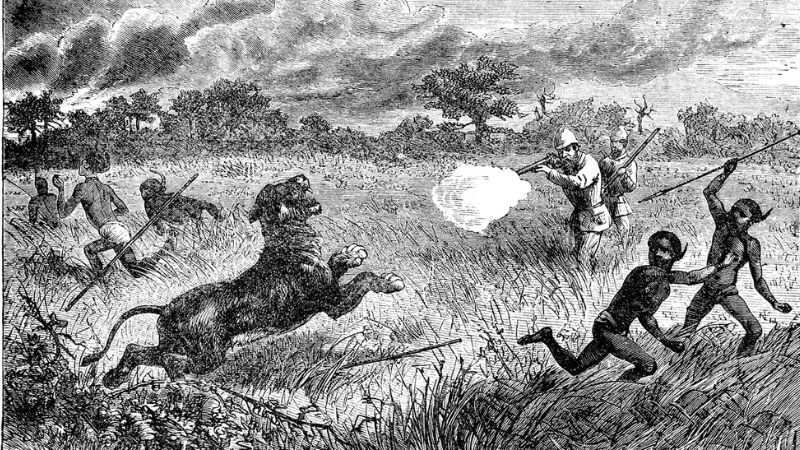
Figures such as Frederick Courteney Selous, William Cotton Oswell, Samuel White Baker, Roualeyn Gordon-Cumming, Henry Morton Stanley and Charles Baldwin became part of the mythology of African hunting. Their books, diaries and expedition accounts helped create the image of the safari as an epic journey into the unknown, made of campfires, double rifles, spoor in the dust, encounters with lions, buffaloes and elephants, and long marches through landscapes that seemed larger than life itself.
Yet this legend cannot be separated from its darker side. The 19th century was also the age of the ivory trade, colonial domination and uncontrolled exploitation of wildlife. Many of the same stories that still fascinate modern hunters are also marked by excess, destruction and moral ambiguity. For this reason, the history of the great African hunters should not be read only as a romantic tale of adventure, but as a lesson. It reminds us that hunting has meaning only when it is guided by knowledge, restraint, respect for animals and awareness of the fragile balance between man and wilderness.
By the end of the 19th century, Africa was a continent shrouded in mystery and legend. For bourgeois and colonial Europe, it represented the “land of beginnings,” an untouched space where nature still spoke with a primordial voice. It was the absolute elsewhere, unreachable and irresistible.
The Dark Continent drew explorers, botanists, soldiers, missionaries, and, of course, hunters. Men in search of glory, trophies, knowledge—or, often, mere adventure. Africa was the ideal canvas upon which to project epic dreams, romantic fantasies, and personal obsessions. It was also a harsh, unforgiving land that tested both body and spirit—and often did not forgive.

The wild allure of late 19th-century Africa was inextricably tied to the figure of the white hunter: hero, anti-hero, storyteller, and explorer. Some of these men became legends, protagonists of books, tales, and chronicles. Their stories, even today, retain a mythical aura, yet cast a long shadow: that of ivory hunting, animal massacres, and colonial domination.
In this journey through the savannas, rivers, and forests of a bygone Africa, we will discover who the great hunters of that century were, what they sought, and what they left behind.
The Age of White Gold: The Ivory Industry Between Domination and Destruction
By the end of the 19th century, ivory was one of the world’s most prized commodities. Known as “white gold,” it was used to produce luxury goods, handles, billiard balls, sculptures, piano keys, combs, and ornamental decorations. Demand was immense, fueled by European and American markets, and Africa became the epicenter of extraction.
This demand transformed hunting from a sporting activity into a systematic industry. Entire expeditions were organized with the sole purpose of finding and killing elephants for their tusks. Ivory caravans, guarded by armed mercenaries, moved from collection points toward the eastern and western coasts, from where the cargo would depart through ports like Zanzibar, Mombasa, Luanda, or Dakar.

The impact was devastating—ecologically, socially, and politically. Thousands of elephants were slaughtered every year, pushing entire local populations to the brink of collapse. African beaters were often reduced to semi-slavery, paid a pittance and exploited to exhaustion. The ivory routes also became routes of human trafficking: slaves and tusks traveled side by side, bearing witness to the brutality of that trade.
Politically, the ivory trade became one of the driving forces of colonial expansion. Large European companies, in collaboration with governments and military authorities, used hunting as a pretext to seize land and resources. The penetration into the African interior was often led by hunters, explorers, and ivory traders, the first to venture where no European had ever been.
While a few, such as Selous or Baker, showed some awareness of the issue, most acted without restraint, driven by profit and glory. It was only in the early decades of the 20th century, with the first conservation policies, that people began to grasp the scale of the disaster. But by then, the damage had been done: in many parts of Africa, the trumpeting of elephants vanished forever.
For hunters who feel the call of Africa but want to approach it with competence, humility and preparation, a first African hunting experience with awareness and method can become the ideal bridge between the old safari myth and a modern, responsible way of hunting.
The Dark Side: The Ivory Hunt
While some hunters acted out of passion or for science, many others were tools or key players in the ivory trade. By the end of the 19th century, elephant tusks were highly sought after in Europe and America, for piano keys, knife handles, and ornaments. Prices rose, and the rifles fired.

Thousands of elephants were exterminated. Entire herds disappeared within just a few seasons. Contemporary accounts, when read with a discerning eye, speak of journeys undertaken solely to find new “herds to work.” Hunting turned into extermination, into industry, into plunder.
Even legendary figures like Selous took part in this activity, albeit with different limits and sensibilities. Only at the beginning of the 20th century did the first forms of protection begin to appear, often initiated by the very hunters who had converted to conservation.
Frederick Courteney Selous: The Gentleman Hunter
Selous is perhaps the most famous of the African hunters of the Victorian era. An Englishman, elegant, educated, and athletic, he was a naturalist as well as an exceptional marksman. He began hunting in Africa in 1871, and for over twenty years explored the regions between the Limpopo and Zambezi rivers.
He authored numerous books, including A Hunter’s Wanderings in Africa, in which he vividly recounted his encounters with lions, elephants, buffalo, and rhinos. He was admired by Theodore Roosevelt, who considered him a model of the ethical and sporting hunter.
Selous died in 1917 during the First World War, in Mozambique, struck by enemy fire while serving as an officer. His name lives on in the great Selous Game Reserve in Tanzania.
Curiosity: It is said that Selous could track an animal for miles without ever losing its trail. He was known for his respect toward animals and his deep knowledge of local tribes.
Among the modern destinations that still preserve the grandeur of the old safari imagination, hunting in Tanzania remains one of the most evocative, with its miombo forests, wild plains and landscapes deeply connected to African hunting history.
William Cotton Oswell: The Hunter Alongside the Explorers
A doctor, adventurer, and naturalist, Oswell is remembered for his expeditions in the Kalahari alongside David Livingstone. He was an excellent hunter, but also a man of strict ethics. He hunted out of necessity and for study, never out of vanity.
He took part in the discovery of the Zambezi River and the lakes region of southern Africa. He was among the first Europeans to hunt elephants in the Kalahari, but his journal is also full of reflections on restraint and respect.

Anecdote: During an expedition, Oswell refrained from shooting an elephant when he noticed it was a mother with a newly born calf. This gesture was greatly appreciated by the local guides, who nicknamed him “big heart.”
Henry Morton Stanley: The Double Face of the Expedition
Famous for having found Livingstone (“Dr. Livingstone, I presume?”), Stanley was also a hunter and man of action. His expeditions in the Congo and along the Lualaba River were marked by clashes, sacrifices, and violence. He was ruthless, determined, and saw hunting as a form of supremacy.

His chronicles describe the killing of elephants, hippos, and large felines in an epic tone. But today, we know that many of his actions were an integral part of the Belgian colonial project, which was often disastrous for the environment and local populations.
Historical Note: Stanley was one of the key figures in opening central Africa to the West, but also one of the symbols of the moral ambiguity of that period. His figure remains controversial.
Roualeyn Gordon-Cumming: The Lion of the Pen

Scottish, military by training, and a passionate hunter, Roualeyn Gordon-Cumming was one of the first Europeans to describe hunting in southern Africa in detail. Between 1843 and 1845, he traveled in areas now part of South Africa, Botswana, and Zimbabwe, hunting elephants, lions, and rhinoceroses.
His book, Five Years of a Hunter’s Life in the Far Interior of South Africa, became a bestseller in England, thanks to its epic and adventurous style. His descriptions are vivid, and his hunting tales – especially those of lion hunts – became legendary.
Anecdote: Nicknamed “the living lion” for the courage he showed during a night attack in which he killed two lions just a few meters from his tent, he was celebrated in London salons as a romantic hero, although his actions were not without criticism for their cruelty.
The landscapes once crossed by explorers and ivory hunters still echo in the great wilderness areas of southern Africa, where big game hunting in Zimbabwe offers a modern, regulated and professionally guided approach to some of Africa’s most iconic species.
Samuel White Baker: Hunter, Explorer, and Defender of Wildlife
Sir Samuel Baker was one of the first Europeans to explore the Upper Nile and discover Lake Albert. He was also great hunter, known for  his mastery with the double-barrel shotgun and the courage he displayed during encounters with elephants, buffaloes, and lions.
His most famous book, The Nile Tributaries of Abyssinia, recounts incredible adventures, as well as naturalistic and anthropological observations.
Curiosity: Despite the intensity of his hunts, Baker was one of the first to denounce the decimation of elephants due to the ivory trade. Married to Florence, a courageous woman who accompanied him on his expeditions, they formed one of the first “safari couples” in history.
Charles Baldwin: The King of Elephants
Little known to the general public but legendary among African hunters, Charles Baldwin is remembered as one of the most prolific “elephant hunters” of the second half of the 19th century.
It is said that he killed over 1,000 elephants throughout his life, mostly in the area now known as Zimbabwe. His feats are noted for their cold-bloodedness, audacity, and deadly accuracy with his two-pound rifle.
Historical note: His deeds, passed down orally and through letters published in English magazines, inspired many young adventurers of the time. However, his name is also linked to the fierce expansion of the ivory trade in southern Africa.

In addition to the well-known names, many other protagonists – often forgotten – contributed to the pages of African hunting: indigenous guides, beaters, and porters. Their knowledge of the land was extraordinary: they could read a track in the sand, recognize the alarm calls of a monkey, and sense the arrival of a predator. These men were the true architects of the success of many expeditions, yet their names were rarely remembered in books.
The interaction between European hunters and local tribes was complex: it moved between mutual respect and colonial imposition. Some hunters, like Selous and Oswell, sought dialogue, learned the languages, and adopted customs. Others used force, exploiting and sometimes harshly suppressing the indigenous populations. Exploring this relationship allows us to understand hunting not only as a technical act but as a meeting (or clash) between cultures.
Where hunting took place: the geography of legendary hunting
The places of great African hunting were often remote areas, on the border between savanna and forest, between desert and river. The most hunted areas in the 19th century were:
-
The Limpopo and Zambezi basins (now Zimbabwe, Zambia, Botswana): the kingdom of elephants and buffalo.
-
The Upper Nile region (Sudan, Uganda): explored by Baker, rich in hippopotamuses, crocodiles, and antelopes.
-
The Kalahari and Bechuanaland (now Botswana): deserts and savannas dotted with waterholes, the stage of Oswell’s expeditions.
-
The Rift Valley and the Great Lakes (Kenya and Tanzania): crossroads of lions, rhinoceroses, and migratory herds.
The aesthetics of the hunter: trunks, double rifles, and trophies

The 19th-century hunter was also an aesthetic symbol. He wore colonial canvas outfits, tall boots, and belts with brass cartridges. He traveled with leather trunks, folding tents, silverware, books, and dream rifles.
Weapons were true works of art: Holland & Holland double express rifles, two-pound Express rifles, finely engraved percussion rifles. The camps were small worlds: with kitchen tents, writing tables, folding armchairs, and carpets.
Trophies were displayed in European drawing rooms but also used as currency to obtain favors or contracts. The obsessive collecting of tusks and horns often intertwined with a narcissistic dimension: the hunter as a dominator, as a collector of power.
Between Myth and Awareness
The great African hunters of the 19th century appear to us today as complex figures. They were adventurers, explorers, naturalists, and writers. Some were pioneers of conservation, while others were protagonists of a destructive economy. Their stories still fascinate us because they tell of an immense and wild Africa, of men standing alone before a lion, of campfires under the stars, and of endless silences.
But reading their exploits today also means reflecting. Understanding the impact of our actions, the fragility of nature, the value of memory, and responsibility.
Because the true hunter, today as then, is not the one who kills the most. It is the one who knows how to look at an animal and, in that moment, feel the beauty of the entire world.
The stories of the great African hunters of the 19th century still speak to the imagination of modern sportsmen, but today their legacy must be approached with a different awareness. The true value of safari is no longer measured by excess, but by respect, knowledge, conservation and the ability to experience wild Africa with humility. For those who wish to discover this world through a modern and responsible perspective, Montefeltro offers exclusive African hunting safaris, where tradition, professional guidance and respect for the wilderness become part of a carefully organized journey.
FAQ
Who were the great African hunters of the 19th century?
The great African hunters of the 19th century were explorers, adventurers, naturalists, soldiers and professional hunters who travelled through Africa during the Victorian age. They hunted elephants, lions, buffaloes, antelopes and other big game, often while exploring regions that were little known to Europeans at the time.
Why did 19th-century hunters go to Africa?
Many 19th-century hunters went to Africa in search of adventure, trophies, scientific knowledge, ivory, exploration and personal glory. For some, hunting was connected to survival and natural observation; for others, it became part of the ivory trade and colonial expansion.
Who was Frederick Courteney Selous?
Frederick Courteney Selous was one of the most famous African hunters of the Victorian era. He was an English hunter, explorer, naturalist and writer who travelled extensively between the Limpopo and Zambezi regions and became known for his books, field knowledge and later association with conservation.
Why is Selous important in African hunting history?
Selous is important because he helped shape the image of the ethical and sporting African hunter. His writings influenced generations of hunters and explorers, and his name became linked to one of Africa’s most famous wildlife areas, the Selous Game Reserve in Tanzania.
Who was William Cotton Oswell?
William Cotton Oswell was a British doctor, explorer, naturalist and hunter who travelled in southern Africa and the Kalahari. He is remembered for his expeditions with David Livingstone and for a more restrained approach to hunting compared with many hunters of his time.
Who was Henry Morton Stanley?
Henry Morton Stanley was an explorer and journalist best known for finding David Livingstone. He was also involved in hunting and expeditions in central Africa, but his legacy is controversial because of his connection with colonial expansion and violent exploration practices.
Who was Roualeyn Gordon-Cumming?
Roualeyn Gordon-Cumming was a Scottish hunter and writer who became famous for his book Five Years of a Hunter’s Life in the Far Interior of South Africa. His vivid accounts of hunting elephants, lions and rhinoceroses helped popularize African hunting stories in Victorian Britain.
Who was Samuel White Baker?
Samuel White Baker was a British explorer, hunter and writer known for his expeditions in the Upper Nile region and for discovering Lake Albert. He hunted elephants, buffaloes and lions, but he also wrote about wildlife and showed early concern for the destruction caused by excessive ivory hunting.
Who was Charles Baldwin?
Charles Baldwin was a 19th-century African hunter remembered as one of the most prolific elephant hunters of his time. His name is linked to the era of large-scale elephant hunting and the expansion of the ivory trade in southern Africa.
What was the ivory trade in 19th-century Africa?
The ivory trade was a major commercial industry based on elephant tusks, which were exported to Europe and America for luxury goods such as piano keys, handles, ornaments and decorative objects. It caused the massive killing of elephants and had devastating ecological and social consequences.
Why is the history of African hunting controversial?
The history of African hunting is controversial because it combines exploration, courage and natural observation with colonial domination, exploitation of local people, uncontrolled killing of wildlife and the destructive ivory economy. It is a history of both fascination and moral complexity.
Did 19th-century hunters contribute to conservation?
Some hunters eventually contributed to early conservation awareness, especially those who witnessed the decline of wildlife populations. However, many others were directly involved in practices that severely damaged animal populations, especially elephants.
What animals did African hunters pursue in the 19th century?
They commonly pursued elephants, lions, buffaloes, rhinoceroses, hippos, antelopes and other large African animals. Elephants were especially targeted because of the high commercial value of ivory.
Where did 19th-century African hunting take place?
Important hunting regions included the Limpopo and Zambezi basins, the Kalahari, Bechuanaland, the Upper Nile, the Great Lakes region, the Rift Valley and areas that are now part of South Africa, Botswana, Zimbabwe, Zambia, Kenya, Tanzania, Uganda and Sudan.
What can modern hunters learn from the great African hunters?
Modern hunters can learn both inspiration and caution from the great African hunters. Their courage, fieldcraft and knowledge of the wilderness remain fascinating, but their excesses also show why modern hunting must be based on legality, ethics, conservation and respect for wildlife.
How is modern African hunting different from 19th-century hunting?
Modern African hunting is regulated by laws, quotas, permits and conservation protocols, while much 19th-century hunting was uncontrolled and often driven by ivory, profit or colonial expansion. Today, responsible hunting must support wildlife management, local communities and habitat conservation.
Why does the myth of the African safari still fascinate hunters?
The African safari still fascinates hunters because it represents wilderness, adventure, danger, beauty and a deep connection with nature. The campfire, the spoor in the dust, the call of lions at night and the vastness of the savanna remain powerful symbols in hunting imagination.
What is the true legacy of the great African hunters?
Their true legacy is complex. They left behind books, stories, maps, natural observations and the romantic image of safari adventure, but also the memory of overexploitation and colonial violence. Their history should be read with admiration for the wilderness and awareness of the responsibility that hunting requires today.