

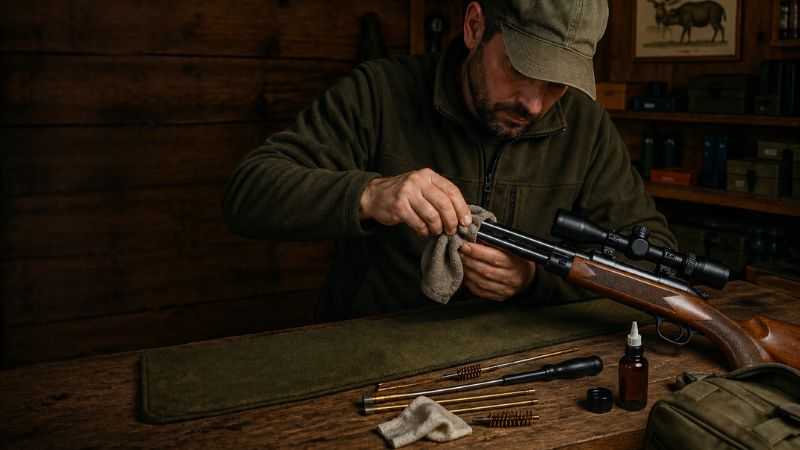
The cleaning of a hunting rifle is not a simple act of maintenance, but a fundamental part of the proper use of the firearm. A dirty or neglected barrel can compromise accuracy, shot consistency, and long-term durability, often without immediate visible signs. Residues of powder, copper, and moisture gradually accumulate, altering performance and increasing the risk of corrosion.
Cleaning the rifle regularly, especially after outings in humid conditions or after firing, helps preserve its efficiency and prevent problems that are difficult to detect. Only a few quality tools and a correct procedure are needed: cleaning from the chamber to the muzzle, controlled use of solvents and oils, and attention to the bolt and external parts.
Conscious maintenance not only improves ballistic performance, but also contributes to safety. Over time, this action becomes an integral part of the hunting experience, transforming from a technical obligation into a true ritual of respect for the firearm.
There is a moment, after the hunt, that makes no sound. It has none of the adrenaline of the sighting, nor the tension of the shot. It is the moment when you return, perhaps with tired legs, cold hands, and a mind still full of images.
That is when the time for cleaning the rifle arrives. A time that many experience as a duty, some as an annoyance, and few, very few, as what it truly is: a gesture of respect.
Those who work with firearms know this well. Maintenance is not optional, nor is it a perfectionist’s obsession. It is an integral part of the correct use of a hunting rifle. It is also one of the points where you can see the difference between those who consider the firearm a simple tool and those who, instead, understand its mechanical, ballistic, and even cultural value.
Cleaning a rifle does not simply mean removing dirt. It means preserving its accuracy, safety, and longevity over time. It means preventing small, seemingly negligible details—a drop of water, a residue of powder, a bit of sweat on the receiver—from becoming, over the passing seasons, serious problems.
Why the rifle must always be cleaned (even when it “does not seem necessary”)
From a technical point of view, a rifled barrel is a delicate environment. The grooves are designed to guide the projectile with micrometric precision, not to coexist with residues of powder, copper, moisture, or oxidation. And yet, that is exactly where, outing after outing, everything accumulates.
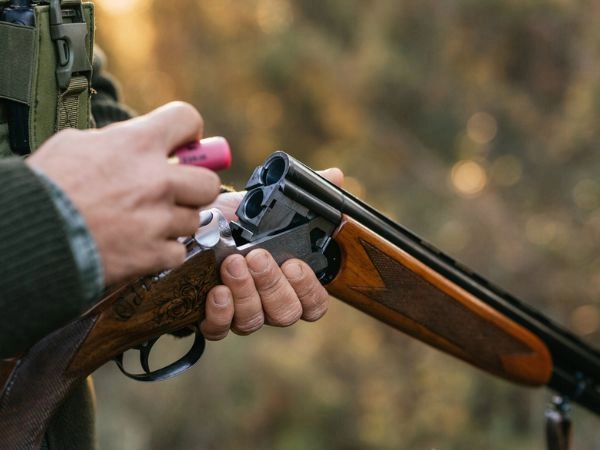
Anyone who has ever looked inside a barrel with a borescope knows what we are talking about. Surfaces that should be shiny become dull, porous. The grooves lose definition, deposits appear, micro-pitting, early corrosion. To the naked eye, nothing is visible. On the target, however, it is.
A neglected rifle:
loses accuracy progressively
becomes less consistent with the first shot
suffers from unexplained variations in the point of impact
ages much faster
And this is where the classic phrases are born: “today it wasn’t performing”, “the bullet didn’t work”, “it must have been the wind”. Sometimes it is true. Very often, it is not.
When to actually clean the rifle
There is no mathematical rule that applies to everyone. The frequency of cleaning depends on how, how much, and where you hunt.
If you have fired in the rain, in the snow, or in very humid environments, cleaning must be done the same evening, without postponing. Water is the number one enemy of steel, and the condensation that forms inside a closed case can cause silent but deep damage.
If you had a short outing, without firing, in dry conditions, you can also wait. But be careful: even just the sweat from your hands or the vapor of your breath, over time, leave traces.
A good practical rule is this: if the rifle has left the house, it deserves at least a careful inspection.
What you really need to clean a rifle properly

There is no need to exaggerate or be tempted by endless kits. You need few tools, but the right ones.
A quality rod, suitable for the caliber and the length of the barrel, is essential. Better if coated in nylon, with a rotating handle: it follows the rifling and reduces the risk of damage.
A properly sized jag, which keeps the patch tight and uniform.
Patches, which can be purchased ready-made or cut from clean cotton fabrics, as long as they do not release lint.
Brushes: in bronze for the most stubborn residues, in nylon when using specific copper solvents. Mixing the two is a classic mistake that only leads to misleading results.
Finally, oil and solvent. Without naming names, there are historic products, born more than a century ago, that work today just as they did then. If you ask an experienced gunsmith, they will immediately understand what you are referring to.
How to clean the barrel correctly
The procedure is simple, but it must be done in order. First of all, safety: unloaded firearm, always. Bolt open, magazine removed, chamber visually and physically checked.
With the bolt removed, you always work from the chamber to the muzzle. Never the opposite. This is a rule that exists for a precise reason: to protect the crown of the barrel, one of the most sensitive parts to damage.
A first patch soaked in solvent is passed through, left to act for a few minutes, then work is done with the brush, without forcing. Full, regular movements. Rushing is useless, and often counterproductive.
You finish with dry patches until they come out clean, and finally with a very light layer of protective oil. No more. Excess does not protect better: it attracts dirt and creates problems.
Dirty patches should not be reused. They cost little, and they are worth a lot.
Not only the barrel: bolt and external parts
Good maintenance does not stop at the barrel. The bolt must be cleaned and dried, especially in the areas where residues and moisture accumulate. The external parts must be wiped with a lightly oiled cloth, without forgetting screws, scope mounts, and less visible parts.
It is precisely there that oxidation often begins.
Before shooting again: a gesture that prevents errors
When you pick up the rifle again after cleaning, always pass a dry patch through the barrel before shooting. Residual oil can alter the first shot, and many “unexplained misses” originate right here.
It is a simple gesture, but it makes a difference.
How to store a rifle so that it truly lasts a lifetime
Cleaning well is only half the job. Storing it poorly cancels everything.
The rifle must be stored clean, dry, and lightly protected, in a metal cabinet or safe as required by law. But be careful: never leave it for long in a case. Cases retain moisture, even when they seem dry.
The ideal environment is stable: no humid basements, no overheated attics. A small bag of desiccant salts near the firearm helps much more than one might think.
Every now and then, even out of season, it is worth taking it in your hands, checking it, wiping it with a cloth. Firearms, like precision mechanisms, suffer from neglect.
A matter of respect, before being a matter of technique

A well-maintained rifle shoots better, lasts longer, and is safer. But above all, it tells something about the person who uses it. It tells attention, experience, awareness.
Those who are beginners should understand it immediately: caring for the firearm is part of hunting, just like studying the territory or respecting the animal. Over time, that silent moment after returning will no longer be an obligation, but a ritual. And like all rituals, when it is missing… you feel it.
For the firearm.
For the hunt.
And, ultimately, also for yourself.
Tips & tricks: practical advice from a gunsmith’s bench (the kind you don’t find in manuals)
After years spent seeing rifles on the bench, new, used, loved, mistreated, some things become evident. Not because they are written somewhere, but because they always repeat themselves. Here is a series of practical tips, the kind that really make a difference over time.
Do not clean “randomly”: clean with a purpose
One of the most common mistakes is cleaning too much… or in the wrong way. There is no need to disassemble half the rifle after every shot, but neither to ignore it for months. The goal of cleaning is not to “polish”, but to remove what causes damage: powder residues, copper, moisture. If a barrel shoots well, do not chase the obsession that “cleaner is better”.
Practical rule: if the rifle is consistent and accurate, keep it that way. Intervene when needed, not out of anxiety.
Never force anything (firearms do not forgive haste)
If something does not slide, does not go in or does not come out, stop. Bent rods, stuck brushes, and damaged threads almost always come from the same cause: haste and unnecessary force.
From the bench: a barrel damaged by a bent rod does more harm than a hundred shots fired without cleaning.
Less oil is almost always better
Oil is necessary, but in minimal quantities. A rifle that “drips” is a rifle that will attract dust, residues, and dirt. Even worse if the oil migrates into the chamber or into the barrel before shooting.
Straight advice: oil yes, but barely visible. If you see it shining, it is probably already too much.
Pay attention to scope mounts
During cleaning many focus only on the barrel, completely forgetting mounts and scope screws. Humidity and temperature changes act there as well.
Workshop trick: every 2–3 outings, check the tightening of the screws (without tightening “by feeling”). Many accuracy problems originate there, not from the barrel.
Not all ammunition fouls in the same way
Changing bullet means changing residues. Some alloys leave more copper, others more carbon deposits. If you often switch from one ammunition to another, the barrel will let you know.
Practical observation: if you change bullet type, always perform a more thorough cleaning before judging the grouping.
The barrel crown is sacred
It is one of the most delicate and important parts, and also one of the most neglected. Impacts, incorrectly inserted rods, improper supports damage it slowly but inevitably.
Golden rule: always clean from the chamber to the muzzle. Always. No exceptions.
Never store the rifle “tired”
After a cold or humid day, the rifle is literally “tired”: cold metal, condensation, internal moisture. Storing it immediately in the safe without letting it air out is a common mistake.
Healthy habit: half an hour at room temperature, then cleaning and storage. Steel will thank you.
Every now and then, really look inside the barrel
A professional borescope is not necessary, but a good light and a minimum of attention are. Looking inside the barrel teaches you to recognize when it is truly clean… and when it is not.
From the bench: those who never look inside the barrel often realize problems only when it is too late.
Treat the rifle like a companion, not like a tool
It may sound romantic, but it is extremely practical. Those who take care of their firearm know it better, handle it better, and shoot better. “Neglected” rifles speak clearly when they arrive at the workshop.
Simple truth: a well-maintained firearm lasts longer than its owner.