
Fishing in South Africa is never just a simple sport activity. It is a direct confrontation with the ocean, with its rhythms, its power, and its unpredictability.
And if there is a place capable of best representing this primordial dimension of fishing, that place is Jeffreys Bay. Known worldwide for its legendary waves, this location in the Eastern Cape also holds one of the most fascinating and demanding stages for those who practice deep-sea and shore fishing.
In Jeffreys Bay the ocean does not make concessions. It is not a background, it is not a postcard. It is the absolute protagonist. And fishing here means accepting a challenge that goes far beyond technique: it is a test of adaptation, respect, and awareness.
South Africa and fishing: a land of contrasts and abundance
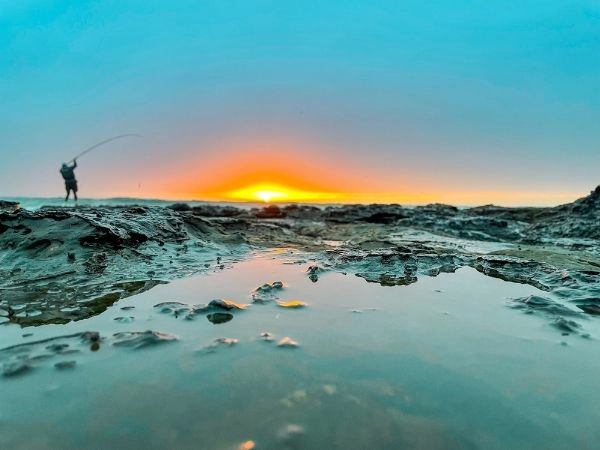
South Africa is one of the most extraordinary countries in the world for sport fishing thanks to its unique geographical position. Here different ocean currents meet, rich ecosystems merge, and a marine biodiversity with no equal is created. The Atlantic Ocean and the Indian Ocean come close, mixing cold and warm waters, creating an ideal environment for an impressive variety of species.
South African fishing is made of vast spaces, wild coastlines, wind, and moving seas. It is not a “comfortable” kind of fishing, but this is exactly what makes it so authentic. Those who choose South Africa do so to live a real, intense experience, often physically demanding.
Jeffreys Bay: much more than a surf destination
Jeffreys Bay is famous worldwide for surfing, but those who only look at the waves miss a fundamental part of its soul. This long, open coastline, beaten by wind, is also one of the most fascinating spots for fishing in South Africa, especially shore fishing and coastal fishing.
Here the ocean constantly changes face. Tides, wind, and currents transform the same beach multiple times in a single day. This makes fishing dynamic, never repetitive, always different. Every outing is an unknown, every cast an opportunity.
Fishing in Jeffreys Bay: reading the sea before casting
Fishing in Jeffreys Bay does not begin with the cast of the rod. It begins much earlier, by observing the sea. Understanding where currents form, where the water changes color, where channels open between the waves is essential. Here, reading the environment is everything.
The fisherman becomes part of the landscape: walking along the beach, studying the movement of the water, waiting for the right moment. There is no hurry. The ocean does not follow human time.
Species: when fishing becomes a confrontation
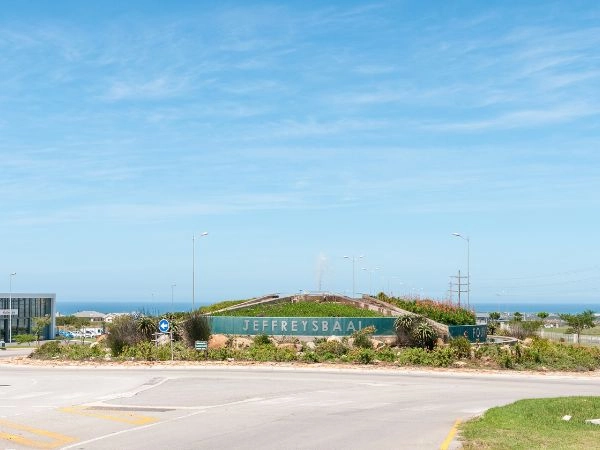
The waters of Jeffreys Bay host a wide variety of species, many of which represent a real challenge even for experienced anglers. Here you do not fish to “make numbers”, but to measure yourself against strong, fast, intelligent fish.
Among the most sought-after species:
- large coastal predators
- impressive-sized rays
- coastal sharks
- powerful fighting fish typical of the Indian Ocean
Every catch is an event. Every fight can last a long time and requires technique, physical endurance, and mental strength. There are no ordinary catches.
The fight: pure strength and respect
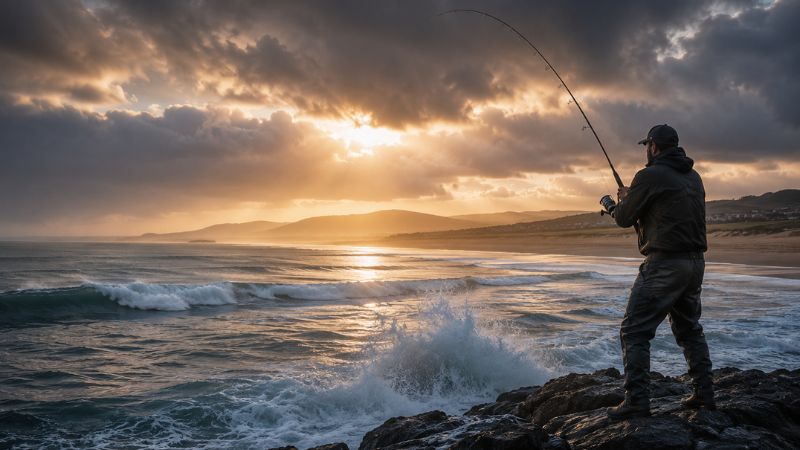
When a fish bites in Jeffreys Bay, you feel it immediately. There is no ambiguity. The rod bends decisively, the line runs, the sea suddenly seems even bigger. In that moment you understand that you are not the one setting the rules here.
The fight is never a matter of brute force. It requires control, the ability to manage tension, to follow the fish without forcing it. The sea is an active part of the confrontation: waves, currents, and wind influence every movement.
And it is precisely in this complexity that South African fishing becomes so engaging.
Fishing as a physical and mental experience
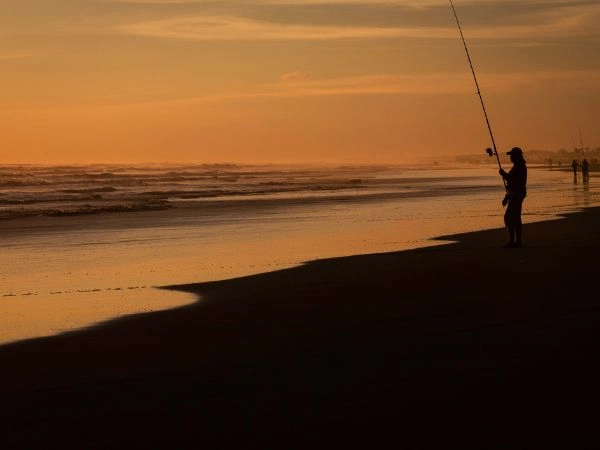
Fishing in South Africa, and especially in Jeffreys Bay, is also a physical experience. Long walks on the beach, constant wind, intense sun, cool nights. The body is always involved. But it is above all the mind that is put to the test.
Here you learn to manage waiting. To live with failure. To return home without catches but with the feeling of having experienced something real. It is fishing that educates, that puts things into perspective, that reminds you that the ocean owes nothing to anyone.
Landscapes and atmosphere: the most authentic South Africa
Jeffreys Bay offers landscapes that get under your skin. Endless beaches, open skies, light that changes rapidly, flocks of seabirds following the currents. The constant sound of the ocean accompanies every gesture.
Fishing here means being immersed in an environment that is never static. Even when nothing happens, the sea continues to move, to speak. And it is precisely this sense of constant change that makes the experience so intense.
Ethics and respect: fishing without possession
In South Africa, more and more anglers embrace a conscious fishing philosophy. Catch & release, especially for large coastal species, is not just a recommended practice, but an ethical choice.
Releasing a large fish after an intense fight is a gesture full of meaning. It is not a renunciation, but a form of respect. It is recognizing that that animal is part of a larger ecosystem that must be preserved.
Why choose Jeffreys Bay for a fishing trip
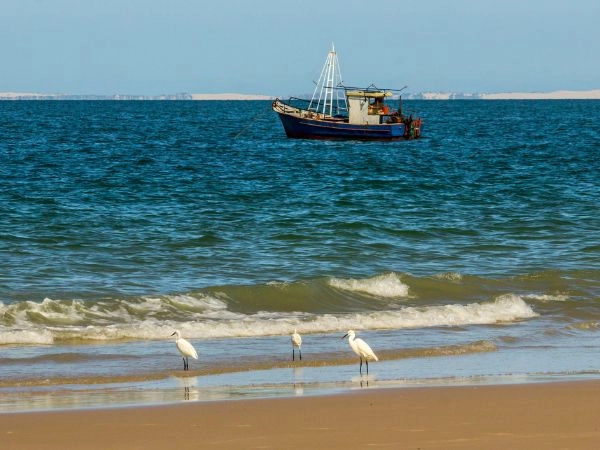
Choosing Jeffreys Bay means choosing real fishing, without filters. It is not a destination for those seeking absolute comfort or guaranteed results. It is a place for those who want to challenge themselves, for those who see fishing as a complete experience made of effort, waiting, and authentic emotions.
Here the sea is not domesticated. It is alive, powerful, sometimes hostile. But precisely for this reason it leaves deep memories that last far longer than a simple catch.
The value of travel: fishing and discovery
A fishing trip to South Africa does not end on the beach. It is also discovery of the territory, of the people, of a culture deeply connected to nature. It is contact with a different Africa, wild yet welcoming, harsh yet incredibly fascinating.
Jeffreys Bay thus becomes not only a place to fish, but a starting point for a broader experience that combines sea, land, and a spirit of adventure.
The ocean as a teacher
Fishing in Jeffreys Bay, South Africa, teaches a simple and powerful lesson: the ocean cannot be conquered. It must be listened to. Respected. Crossed with humility.
Those who return from this experience often talk little about catches and much more about sensations. About the wind. The light. The effort. The silence between one wave and the next.
And perhaps this is the true sign of a great fishing experience: when the sea stays inside you much longer than the memory of a fish.
The return from the ocean: Luca B.’s story after Jeffreys Bay
When I returned from South Africa, the first feeling was strange: everything seemed still. The traffic, the people, the everyday noises. After days spent in front of the ocean of Jeffreys Bay, that continuous movement, that force that never stops, my home world suddenly seemed much smaller.
Fishing in South Africa, at least as I experienced it with Montefeltro, is not something you easily archive. You do not tell it in terms of “success” or numbers. It is something that stays with you even when you dismantle your rods, close your suitcase, and board the plane back home.
Jeffreys Bay is a place that does not welcome you, it tests you. The sea is never the same. It changes with the wind, the tides, the light. Every morning was different from the previous one. And every day you understood that you were not there to impose anything, but to adapt.
I clearly remember the first hours on the beach. Before even fishing, I found myself observing. The sea was huge, open, without reassuring reference points. There were no barriers, no shelters. Only the ocean and you. It was at that moment that I understood this would not be a “relaxing” fishing trip. It would be real fishing.
Every outing required total attention. Reading currents, identifying channels between waves, choosing when to cast and when not to. In Jeffreys Bay you quickly learn that the mistake is not casting badly, but casting at the wrong moment. The sea sets the timing. Always.
When the fish arrived, I felt it immediately. There is no confusion, no doubt. The rod bends sharply, the line runs hard, and the ocean suddenly feels even bigger. In those seconds everything else disappears: it is just you, the fish, and the sea.
The fight was long, physical, demanding. Not only because of the fish’s strength, but because of everything around it: waves, backwash, wind. Every movement had to be calculated. Forcing was not an option. I had to learn to follow, to give in when needed, to recover only when the sea allowed it.
And it was there that I understood what makes this experience special. It was not the catch itself. It was the confrontation. Not against the fish, but against the ocean, against my limits, against the temptation to control everything.
The release was natural. There was no hesitation. After such a fight, keeping that fish would have made no sense. I watched it disappear into the waves in seconds, as if nothing had happened. And in that moment I felt something strange: not loss, but completeness.
In the following days I understood that the real richness of Jeffreys Bay was also in the moments when nothing happened. The long walks on the beach, the constant wind, the sound of the ocean that never stops. It is fishing that clears your mind, forcing you to stay in the present.
With Montefeltro I never felt the need to “bring something home”. No pressure, no imposed expectations. There was respect for the sea, for its timing, for what it could offer. And this approach allowed me to live the experience fully, without frustration.
Coming back home, I realized I talked less about fish and more about the sea. About the wind. The effort. The silence that comes only when you stop fighting the environment and start listening to it.
Jeffreys Bay taught me something simple but fundamental: fishing is not always a conquest. Sometimes it is a conscious surrender. You accept not being the center. You accept being a guest.
I know this experience will stay with me for a long time. Not as something to show off, but as a reference point. A different way of understanding fishing. And perhaps, also travel.