
There is a moment, just before the savannah wakes, when Africa breathes slowly.
The sky is a grey blade opening above the swamps, the mist rises like thick smoke, and the sounds of the world seem suspended.
Antonio R. remembers it well.
It was his third day of hunting in the Zambezi Delta when he understood that this adventure would not be just a hunting trip, but a test of respect and courage—a challenge with nature in its most primordial form.
Between Water and Mud: The Theatre of African Hunting
The Mozambican swamps are not like the bright savannahs featured in safari magazines.
They are a different world: a maze of tall grass, stagnant water, hidden channels, and mud that swallows your boots. A wild, humid, difficult territory where every step can reveal a surprise—or a danger.
This is the home of the African swamp buffalo, the legendary Syncerus caffer caffer, an imposing, tough animal with a dark, unreadable stare.
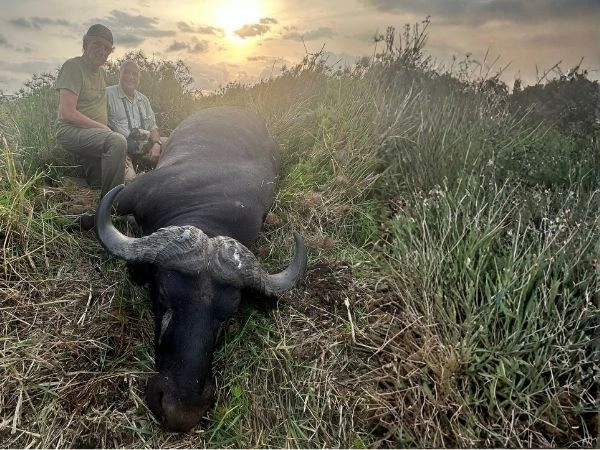
Bulkier than the savannah buffalo, with wider horns and a compact body, it loves to hide in marshlands where man struggles to follow.
And it was here that Antonio, an experienced hunter and a lover of authentic challenges, had chosen to confront one of Africa’s Big Five.
At his side, as always, was Luca Bogarelli, Montefeltro professional guide—an expert hunter and a man capable of reading the wind like a map.
The Briefing: Silence, Strategy, and Respect
Buffalo hunting does not begin with a shot, but with silence.
Every morning at dawn, Luca and the Mozambican tracker planned the approach. The swamps do not forgive mistakes: visibility is limited, and the buffalo hears, smells, and reacts before you ever see it.
Antonio knew it.
He listened to the briefing like one listens to an ancient ritual:
“Never underestimate a buffalo,” Luca reminded him. “Because a wounded buffalo doesn’t run. It waits for you.”
A simple piece of advice, but one that weighs like a warning.
The plan was clear: follow fresh tracks along the higher ground, where the mud reveals clean prints, and move upwind, using the currents that sweep from inland toward the sea. Every step measured, every gesture deliberate.
A buffalo will not give you a second chance.
The First Track
The first real track came on the fourth day. The tracker stopped, bent down, and pointed at a deep print in the mud. Fresh.
The pungent smell of buffalo filled the air, mixed with the sweet rot of marsh vegetation.
Antonio raised his .416 Rigby express rifle, perfectly balanced. Luca signaled him to advance slowly through the reeds brushing against his face.
Every meter gained was a conquest: the ground gave way, mud reached their knees, mosquitoes swarmed in buzzing clouds.
Then—a dull sound. A breath. Ahead, a movement among the rushes. Luca placed his hand on Antonio’s shoulder.
“He’s there.”
The First Encounter
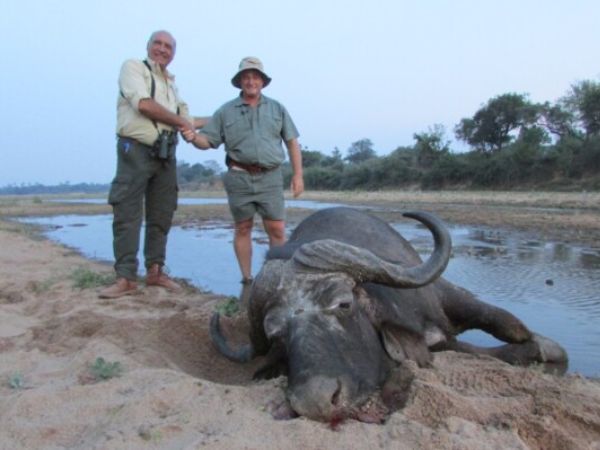
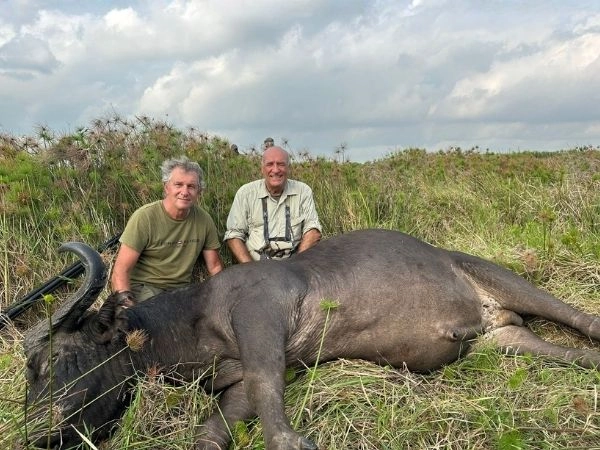
The buffalo emerged like a black shadow separating from the landscape. Massive, powerful, head lowered, horns shining with mud. Over 700 kilos, at thirty meters.
The wind was good, but a single mistake could make him turn. Antonio felt his heartbeat in his ears. Luca, crouched beside him, whispered:
“Wait until he turns his head. Shot right behind the shoulder—precise.”
The buffalo shifted sideways, slowly, as if sensing something. Antonio’s finger tightened. The shot broke—sharp, powerful. The bullet hit the exact spot, the buffalo staggered but did not fall.
It turned, growling, eyes red with anger.
“Double him!” Luca shouted. And Antonio did—instinctive, fast, precise. The second shot hit just above the first, devastating.
The buffalo took two steps back, then collapsed heavily into the mud.
Silence.
Only the sound of their heavy breathing and the slow rustle of water.
The Moment of Respect
Antonio did not approach immediately. Luca stopped him with a hand.
“Wait. Look at him. Breathe.”
It is a sacred rule of African hunting: give respect its time.
The buffalo lay still among the reeds. Antonio watched it, knowing this was not triumph but gratitude. Then, with the tracker, he approached.
The animal was majestic, body still warm, horns wide like a natural crown. Antonio placed a hand on its flank, in silence.
“It’s not a trophy,” he whispered. “It’s a gift.”
Luca nodded. “As it should be.”
Recovering a buffalo in such conditions is no small task. It took hours to extract it from the mud, with help from locals and a small amphibious tractor. Water up to their knees, crocodiles not far away, every move calculated. But the sun, sinking over the golden reflections of the swamps, gave the moment an indescribable solemnity.
When they finally returned to camp, the sky was burning red. Antonio looked at his mud-covered rifle and thought: this is the real Africa—harsh, difficult, and unforgettable.
Luca Bogarelli and the Art of Guiding
Anyone who has hunted with Luca Bogarelli knows that his guidance is never just technical—it is an education.
Luca does not simply accompany you; he teaches you. To observe, to read terrain, to understand animal behavior before it appears.
“Every hunt in Africa is a balance between instinct and reason,” he explains. “You cannot impose anything. You must adapt, wait, feel. The buffalo is the highest test because it forces you to measure yourself.”
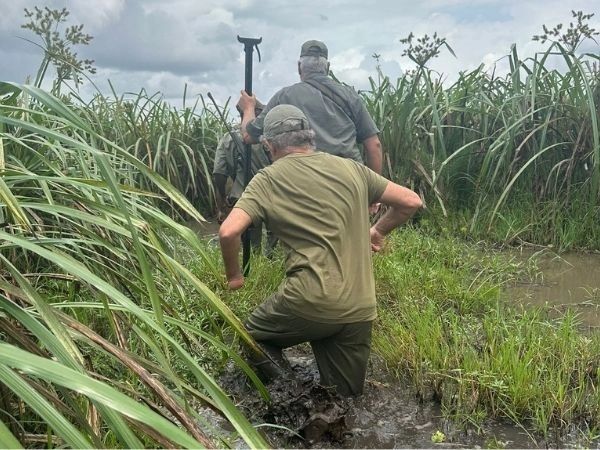
Hunting in the swamps, in particular, requires a different mental preparation:
-
You must master fear, because the terrain offers no escape routes.
-
You must trust your team—every decision is collective.
-
You must accept slowness—here you do not rush, you endure.
The Right Caliber: Power According to Bogarelli
When it comes to Cape buffalo, there is no middle ground.
A buffalo embodies Africa’s strength: over 700 kg, thick bones, tough hide, and an ability to absorb bullets that surprises even veteran hunters.
This is why Luca has no doubts: for such an animal, you need a caliber that leaves no room for uncertainty.
The classic .375 H&H remains a historic reference, but Luca has developed a preference for two giants of African ballistics: the .416 Rigby and the .378 Weatherby Magnum.
.416 Rigby – Authority and Control
For many, the .416 Rigby is the true African caliber.
Created in the early 1900s and consecrated by legends like Karamojo Bell, it was designed for a single purpose: stopping dangerous game.
Luca chooses it for a simple reason: devastating power without sacrificing precision.
A 400-grain bullet at over 700 m/s maintains a flat trajectory and deep penetration, even through the hardest bones.
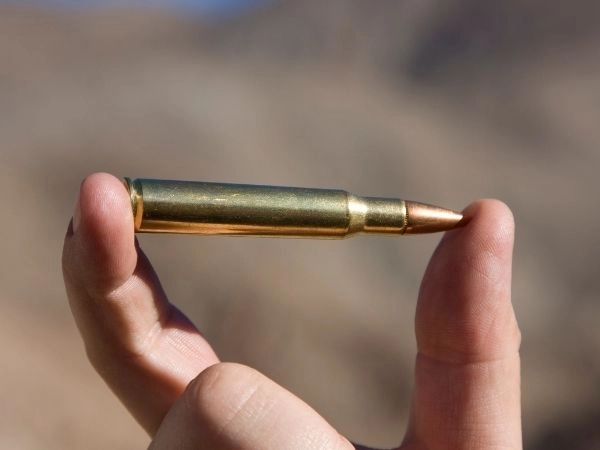
“The .416 doesn’t shout,” Luca says. “It works. If your first shot goes where it must, you won’t need another.”
Despite its power, the recoil remains manageable thanks to its classic, progressive impulse.
.378 Weatherby Magnum – The Hammer of Modern Africa
In open terrain, longer distances, or unpredictable conditions—like Mozambican marshes—Luca prefers the .378 Weatherby Magnum.
Modern, brutal, and American in philosophy: pure energy.
With bullets at over 850 m/s and more than 7,000 joules of energy, it is one of the most powerful sporting calibers ever made.
What matters to Luca is not raw power, but its ability to instantly disable even the toughest buffalo.
“The .378 doesn’t forgive. If you’re precise, the buffalo drops where it stands.”
Why the .375 Is Not Enough
Luca calls the .375 H&H “a reliable gentleman,” but he is realistic: Africa is not gentle.
“The .375 is great for first-timers or open spaces where you can fire again. But in mud, reeds, mopane thickets—where the buffalo senses you before you sense it—you need something that ends the story immediately.”
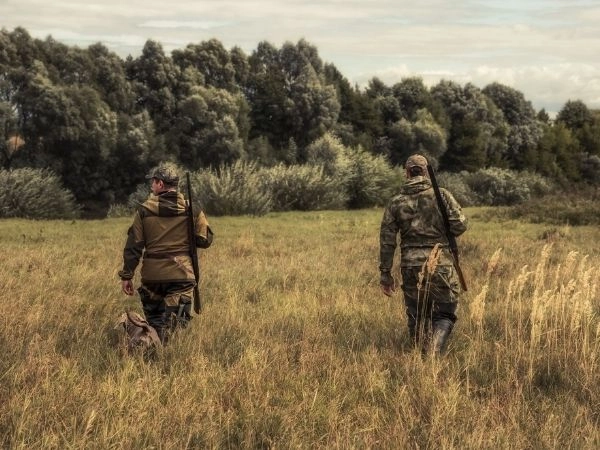
And that means .416 or .378.
In many cases, the .375 can be sufficient, but it demands perfect shot placement and a great deal of composure—two factors that rarely align when a furious buffalo is twenty meters away.
With larger calibers, however, the operational margin widens. Even a slightly angled shot, if well executed, retains enough stopping power to bring the animal down.
And in Africa, that margin can mean the difference between an unforgettable experience and a tragedy—between life and death.
Luca’s Philosophy: “Choose Your Rifle as You Choose a Companion”
For Luca, the right caliber is not about numbers—it is about identity.
Instinctive, fast hunters who move light prefer the .416.
Hunters who seek absolute finality prefer the .378 Weatherby.
“There is no perfect caliber for everyone. Only the one that makes you calm when the buffalo disappears into the reeds.”
The Ethics of Power
There is one thing, however, that Bogarelli always emphasizes to his clients: power is nothing without discipline.
A large caliber is not a shortcut—it is a responsibility. The .416 or the .378 do not forgive mistakes in positioning, handling, or readiness. They must be understood, tested, internalized.
Luca always insists on the concept of “ballistic intimacy”: the hunter must know exactly where the bullet lands at 25, 50, and 100 meters, and how the rifle reacts under recoil.
“Before you step into the savannah,” he says, “you need to be one with your rifle. Because in there, there’s no room for thinking. There’s only room for action.”
Between Tradition and Modernity
Interestingly, both the .416 Rigby and the .378 Weatherby represent two opposing eras of African ballistics.
The former is a product of the colonial era, of foot hunts, from a time when the only certainty was the quality of the steel and the hunter’s composure.
The latter, on the other hand, is a product of modern engineering, designed to make the most of every gram of energy, with flat trajectories and surgical precision.
Yet, both express the same principle: respect for the animal and the necessity of a quick, clean, ethical kill.
It is not power for its own sake, but moral effectiveness: a single, precise shot that spares the animal unnecessary suffering and the hunter from risk.
The Sound of Safety
When walking through the swamps of Mozambique or among the acacias of Botswana, the sound of a buffalo breaking the silence leaves no room for hesitation.
In that instant, everything boils down to a gesture, a shot, a sharp sound.
This is why Luca keeps saying, “The caliber is not a detail: it is your voice in the middle of the savannah.”
And when he speaks, he prefers it to be heard loud and clear.
For him, the .416 Rigby and the .378 Weatherby Magnum are not instruments of power, but guarantees of respect.
Because in the wild heart of Africa, the difference between hunter and predator lies entirely in the awareness of using force only when necessary, but to the best of one’s ability.
Equipment: When Africa Does Not Forgive
In the swamps of Mozambique, every detail matters. This is why Luca and Antonio follow the golden rule of Montefeltro professionals: travel light, but perfectly equipped.
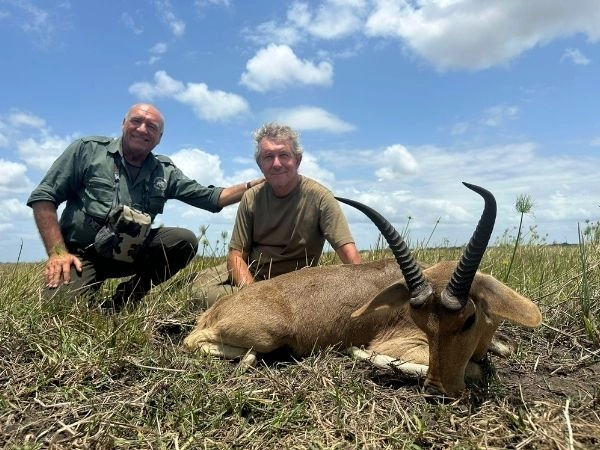
Clothing
-
Breathable technical shirts, made of cotton or waxed fabric, in neutral colors (khaki, olive, sand).
-
Durable trousers with reinforced bottoms for the mud.
-
Lightweight waterproof jacket: the weather can change in minutes.
-
Wide-brimmed hat and scarf for the neck.
Boots and Protection
-
Swamp boots or waterproof hiking boots with technical socks.
-
Lightweight gloves to protect hands from cuts by tall grass.
-
Mosquito repellent and long-lasting sunscreen.
Optics
-
Spotting scope with 1–6x or 1–8x zoom, illuminated reticle.
-
8×42 binoculars with anti-fog coating.
-
Rangefinder useful for openings between reeds.
Safety and Logistics
-
GPS and portable radio.
-
First aid kit and updated tetanus serum.
-
Waterproof backpack with quick-access compartments for ammunition and water.
Africa is not for improvisers. Every mistake, even small, can be costly. “Comfort is not a luxury,” says Luca, “it’s safety. And safety is respect for life.”
The Meaning of an Authentic Hunt
After returning to Italy, Antonio often recounted that experience, his eyes still full of Africa.
“It’s not a hunt you forget,” he says. “It marks you. It teaches you calm, fear, gratitude. There is no other place in the world where nature feels so close, so alive, so honest.”
Many expect an African safari to be a sequence of trophies, but the truth is different. It is an experience of mutual recognition between man and animal, between hunter and environment. The buffalo, more than any other species, represents nature’s raw strength and the limits of man.
Hunting it is not about domination, but about acknowledging that limit and accepting it.
The Perfect Contrast: Power and Silence
One image stayed with Antonio: the return to camp at dusk.
The cleaned rifle, the fire, distant ranger voices.
No frenzy. No celebration.
Only silence.
“Africa doesn’t shout at you,” he says. “It speaks softly.”
Perhaps this is the eternal appeal of African hunting: the contrast between force and humility.
Advice for Those Who Dream of Mozambique
-
Train physically—buffalo hunting is demanding.
-
Practice fast shooting—often under 50 meters.
-
Choose the right caliber—.375 H&H minimum, .416 for experts.
-
Never hunt alone—a buffalo may charge minutes after being hit.
-
Respect the guide—your life depends on him.
-
Seek the experience, not the biggest trophy.
-
Remember the Montefeltro ethical code: every animal is a gift.
The Future of African Hunting
Regulations evolve, concessions renew, sustainability becomes central.
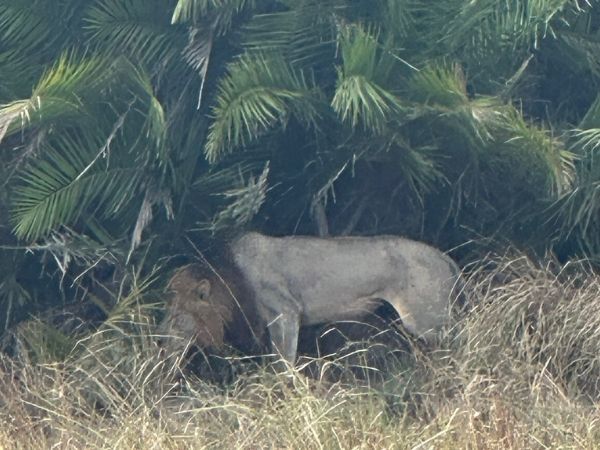
Montefeltro, with its network of partner reserves in Mozambique, Zimbabwe, and South Africa, promotes a model of ethical and conservation-focused hunting, where controlled harvesting funds wildlife protection and supports local communities.
In many villages, the presence of hunters provides jobs, infrastructure, and security. It is only an apparent paradox: well-managed hunting protects nature better than poaching or abandonment. It is within this framework that experiences like Antonio R.’s become tools for conservation, as well as for passion.
Between Mud and Sky: A Lesson in Humanity
When it comes to African hunting, people often think of trophies, photos, and myths, but the truth is simpler—and deeper. True hunting is humility.
Antonio understood this when he returned for the last time to the marshes, just a few days before departure. He stopped on the same bank where he had shot his buffalo and watched the water move slowly, the sky low, the wind salty.
No words. No poses.
Only the awareness of having shared, for a few days, the sacred space of the wild. Luca joined him and placed a hand on his shoulder. “Did you enjoy Africa?” he asked.