

Whether it is a classic English-style driven shoot or a traditional walk-up hunt with pointing dogs in the rolling hills of northern Italy, pheasant hunting remains a deeply rooted tradition that continues to exert an irresistible appeal on hunting enthusiasts around the world.
This enduring bond between humans and the pheasant has ancient origins, shaped by a shared history spanning thousands of years.
From antiquity to the present day, pheasants have travelled across continents alongside humankind. Today, it is hunters who travel far and wide in pursuit of this magnificent bird, seeking it in some of the most evocative landscapes on the planet.
The Origins of the Pheasant
The common pheasant, also known as the ring-necked pheasant, is believed to have originated in what is now modern-day China. From there, it gradually spread westward toward the Black Sea and the Balkans, both through natural expansion and with human assistance.
Fossil evidence suggests that Europeans were already hunting and consuming pheasants as early as 6000 BC. The pheasant’s scientific name, Phasianus colchicus, derives from the River Phasis (today known as the Rioni) and the ancient region of Colchis, located in present-day Georgia.
It was in this legendary land—famed for the myth of Jason and the Golden Fleece—that the Romans discovered another treasure: a striking bird with golden plumage, short wings, a long tail, and exceptionally fine meat.
The Pheasant’s Journey Through the Centuries
The Romans, ever drawn to luxury and refinement, quickly adopted the pheasant as both a culinary delicacy and a prized game species.

Pheasants were bred in aviaries throughout the Roman Empire, becoming symbols of prestige and elegance. With the fall of the Empire, these aviaries were abandoned, and surviving birds dispersed freely across Europe.
Over time, pheasants established themselves from England to Italy, Spain, and the Balkans. They soon became one of the most sought-after quarry species among European nobility, hunted with falcons, bows, and eventually the earliest firearms. Thus began a hunting tradition that would endure for centuries.
The Tradition of Pheasant Hunting in Italy
In Italy, pheasant hunting holds a particularly esteemed place in the country’s hunting heritage. Over generations, it has evolved into one of the most refined and respected forms of game shooting. Italian hunting estates, such as the renowned Montefeltro reserves, represent the pinnacle of this tradition.
Set within breathtaking landscapes, these estates offer an experience where natural beauty meets expertly organised hunting. Pheasants are carefully bred, released into vast areas, and allowed to live freely in environments that closely replicate natural conditions, ensuring an authentic and ethical hunting experience.
The Montefeltro reserves are widely regarded as a true paradise for pheasant hunters. Every detail—from habitat management to game rearing—is meticulously planned to deliver a world-class experience. Hunters may take part in traditional driven shoots, with birds skilfully flushed by experienced beaters, or opt for walk-up hunting accompanied by highly trained pointing dogs, masters at locating and holding pheasants.
The Challenge of Pheasant Hunting
Pheasant hunting is a discipline that demands skill, patience, and a deep understanding of the bird’s behaviour. In Italy, the rolling and often demanding terrain of the Montefeltro estates adds an extra layer of challenge.

Accustomed to wide open spaces, pheasants can be elusive and fast, requiring hunters to adapt their strategy, choose the right moment to shoot, and rely on suitable firearms—often classic Italian over-and-under shotguns, celebrated for their balance, precision, and reliability.
One of the most captivating aspects of pheasant hunting in Italian reserves is the seamless blend of tradition and modernity. While game management and hunting methods are rooted in centuries-old practices, the organisation of shoots and the hospitality offered to guests meet the highest contemporary standards, ensuring a refined and memorable experience.
The Pheasant Around the World: From Europe to America
While Italy stands among Europe’s most prestigious destinations for pheasant hunting, the journey of this bird did not end there. Pheasants were introduced to new continents by European settlers eager to recreate familiar hunting traditions abroad.
In the United States, pheasants were successfully introduced in the late 19th century and found an ideal habitat in the vast prairies of the Midwest. Today, they are one of the most popular game species among American hunters.
Pheasant hunting in the United States is considered both challenging and deeply rewarding. Hunters often cover long distances across open plains, sometimes in harsh weather conditions, in pursuit of these birds. Success depends not only on shooting skill, but also on the partnership with well-trained hunting dogs capable of locating, flushing, and retrieving game across expansive and rugged terrain.
A Journey That Continues
Today, the pheasant’s global journey may be considered complete, having found suitable habitats across much of the world. Yet the journey of hunters in pursuit of this noble bird continues—leading them to new destinations and unforgettable experiences.
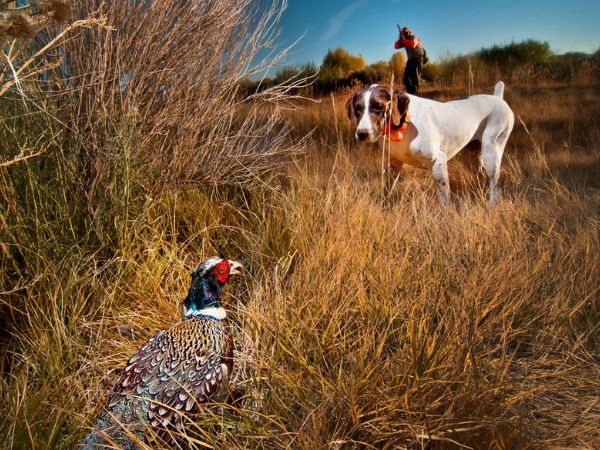
Whether it is a driven shoot in the American Midwest or a day spent among the hills of Montefeltro, pheasant hunting remains one of the most captivating and rewarding pursuits for any true sportsman.
It is not merely about taking a trophy, but about immersing oneself in a centuries-old tradition that continues to unite humanity and nature through respect, challenge, and admiration.